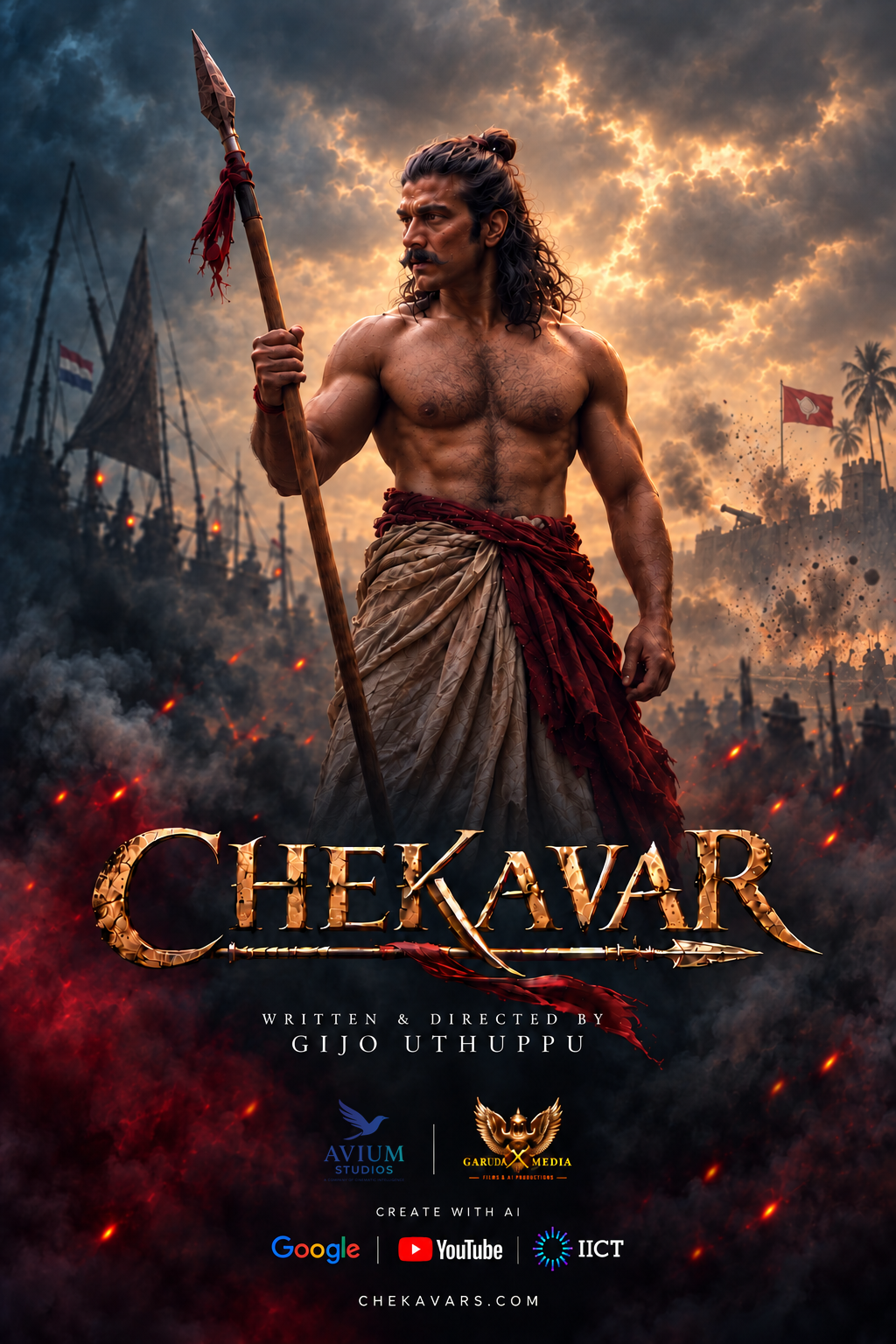
When war reaches the coast, a warrior must decide what he is willing to defend.
A note from the filmmaker
History remembers the battle. I wanted to imagine the people who might have felt its approach: their fear, their love of home, and the courage asked of them. Chekavar is a fictional story with invented characters, set against the real Battle of Colachel in 1741.
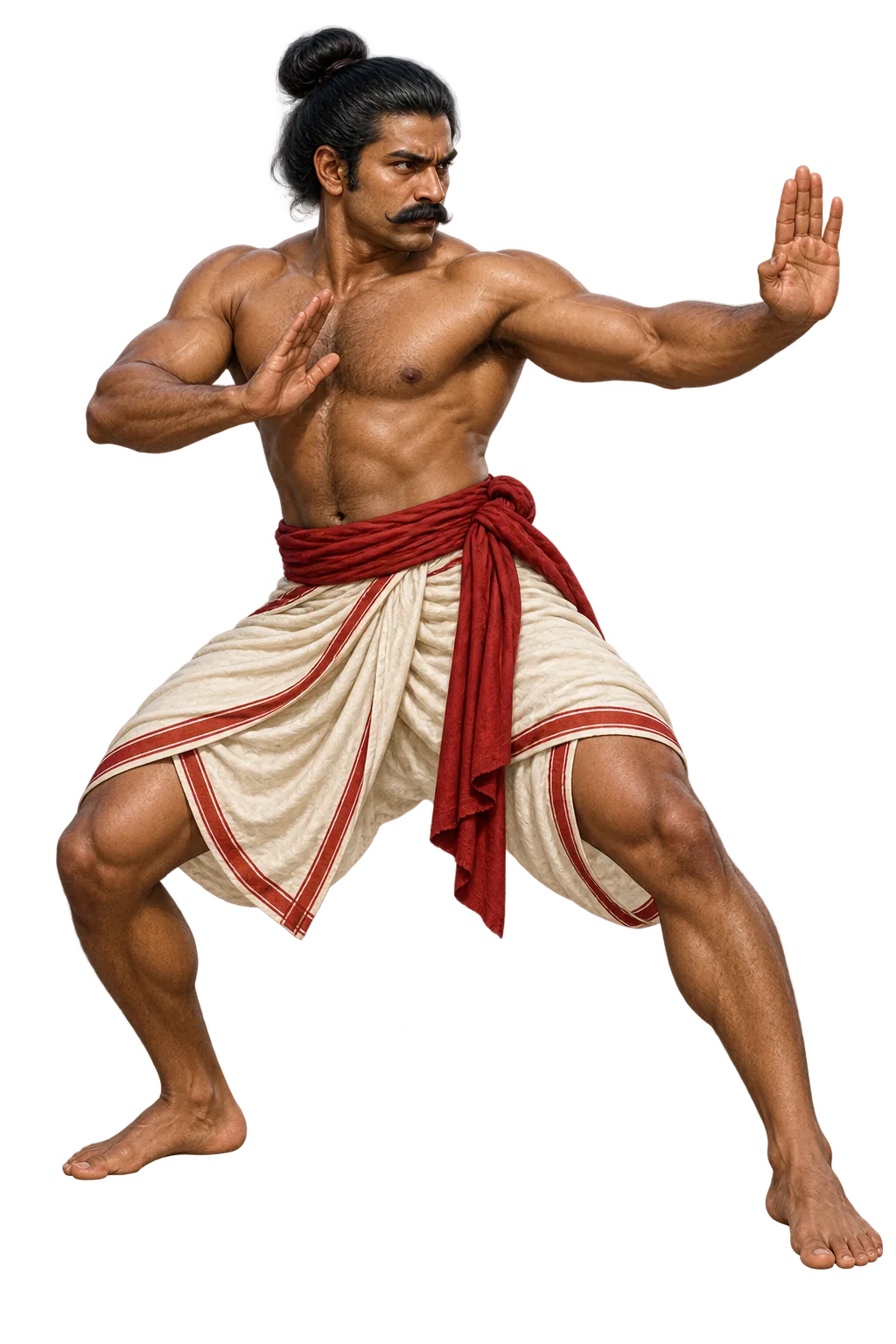
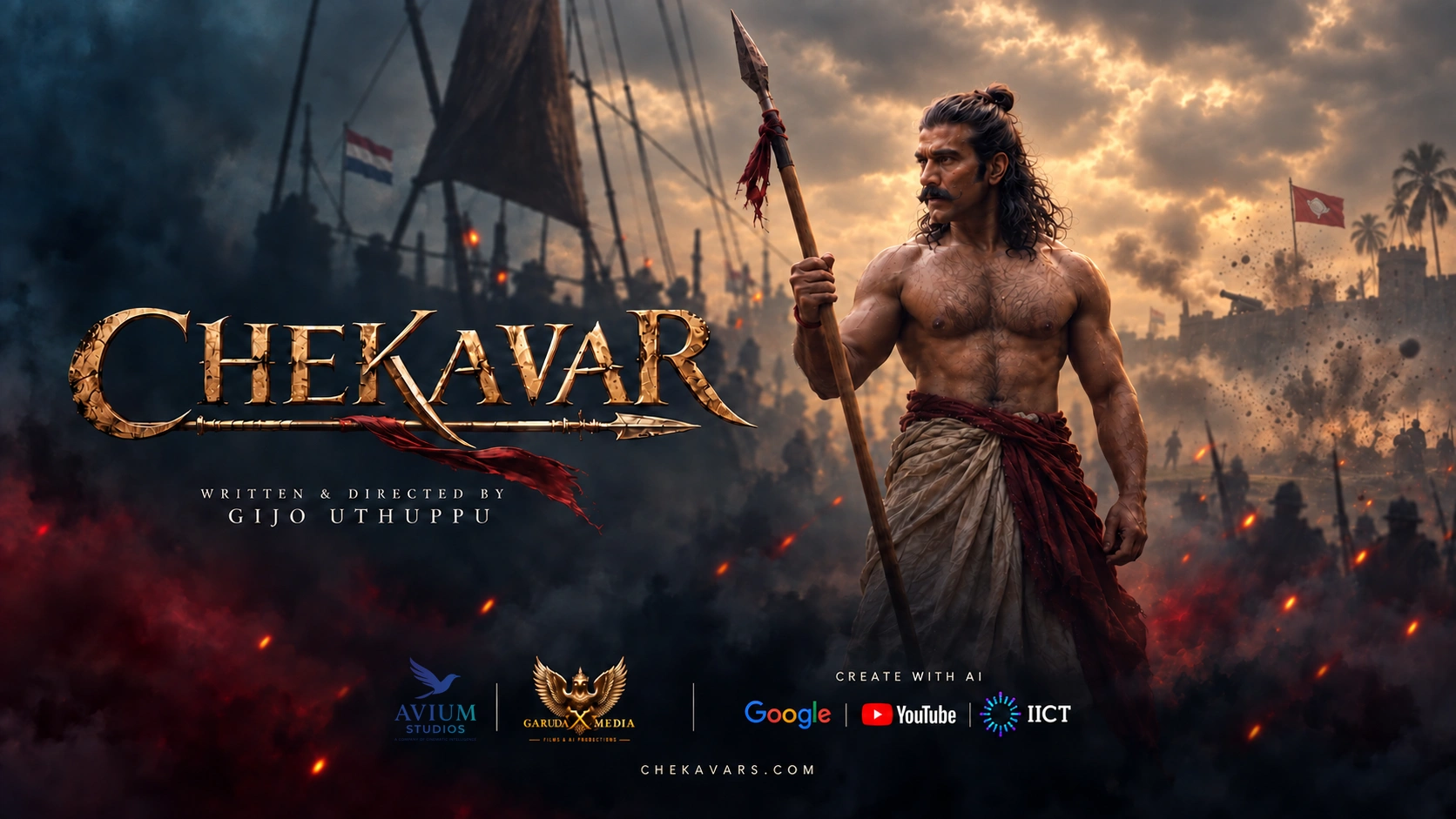
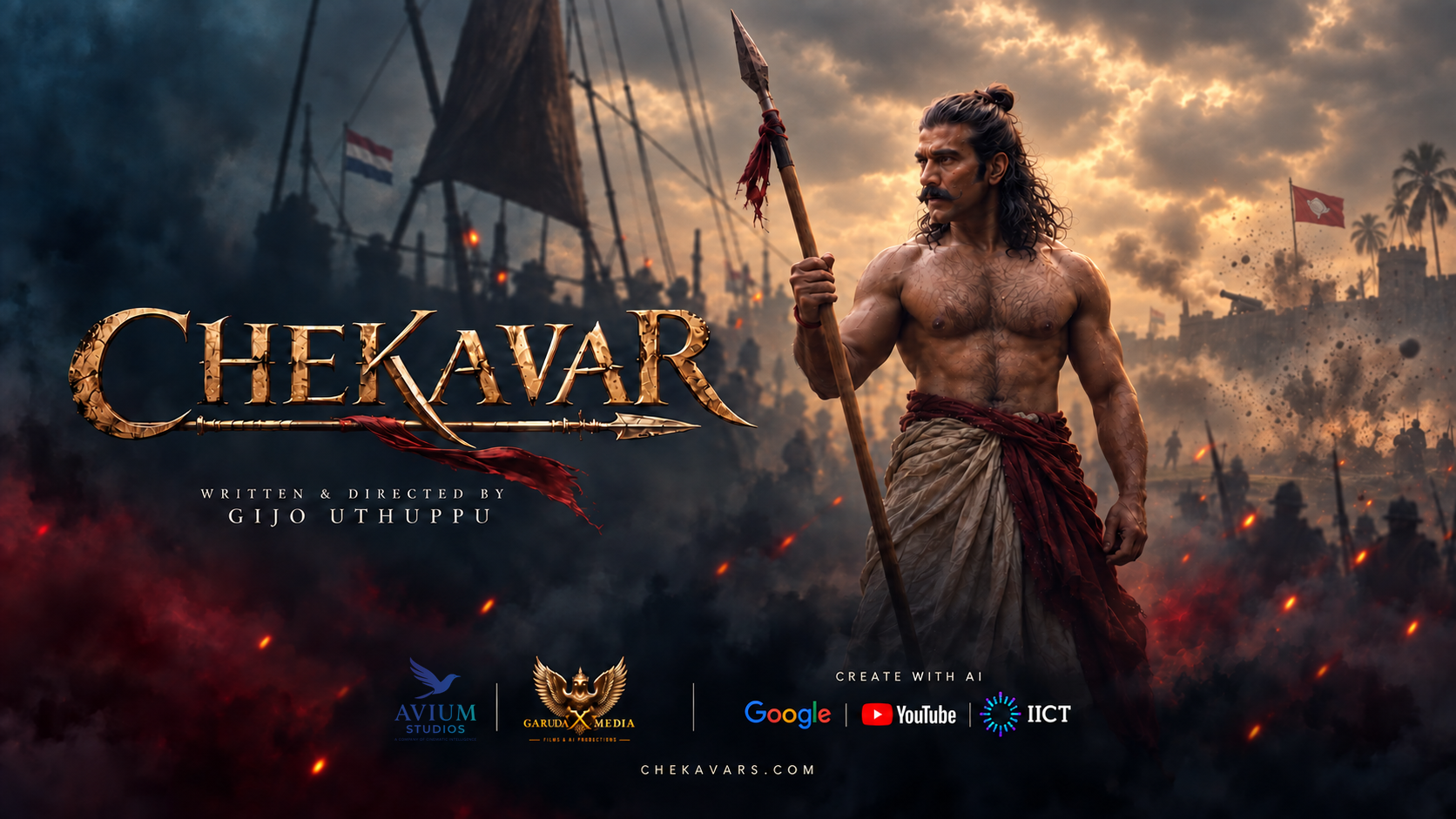
In this 30-minute Hindi historical action drama, Dutch ships approach the Travancore coast. Kandan, a Kalari master, joins fishermen and recruits defending their home. The battle of Colachel and its outcome are real; Kandan and the film’s central characters are fictional.
02 / WHAT WE CREATED
A world built for this story.
Chekavar is an AI-first film. AI is part of the core image-making process, creating the period world, Dutch fleet and large battle sequences. The film begins with a director’s story and shot choices, uses human performance to guide action and emotion, and reaches its final form through editing, music, sound and colour.
03 / WHY IT MATTERS NOW
Remember the people on the shore.
Colachel’s victory is a remarkable chapter in Travancore’s history. Chekavar imagines the fear and resolve of ordinary people on that shore, making an often overlooked past feel immediate. Its themes of belonging and shared courage speak to the present. The film also opens a new production path for ambitious stories that once required much larger physical resources.
AI-FIRST · FILMMAKER-LED
Scale comes from AI. Meaning comes from filmmakers.
AI helped Chekavar create a 1741 coastal world at the scale the story needed. It did not decide what the film should say. The writer-director and cinema team chose the point of view, performances, framing, rhythm and emotional arc; AI became a production medium for bringing those choices to the screen.
01 / DIRECT THE SCENE
Story, blocking, shot design and Kalari action begin with filmmakers. Real movement and performance references give the generated images physical timing and human intention.
02 / BUILD THE WORLD
AI creates and extends period locations, ships, crowds and large-scale action. Iteration lets the team refine light, continuity, camera perspective and small expressions against the director’s vision.
03 / MAKE IT CINEMA
Editors shape pace and feeling; artists refine images and continuity; the music director, sound team and colourists build the final sensory experience. Their judgement turns generated material into a film.
THE MUSIC · CINEMA OF SOUND
Hear the story from within.
Cinema of Sound is Chekavar’s approach to using music and sound to tell the story beneath the dialogue. Music director Mehul P Vyas layers instruments, textures, rhythm and different frequency ranges around the action. A low pulse may create unease; a widening soundscape may bring relief or wonder. These cues are designed to reach the audience instinctively, sometimes before they consciously identify what has changed, and to make the world feel more dimensional.
THE GRADE · CINEMA OF COLOUR
Feel the world through colour.
Cinema of Colour is Chekavar’s approach to grading each scene for its emotional meaning. Warmth, contrast and hue shift with Kandan’s journey: gold can suggest resolve, aqua can open the space, and red can draw attention to danger. Colour can influence mood before a viewer stops to analyse it. The grade is designed to work on that instinctive level, so the audience feels the scene as well as sees it.
THE CREATIVE COLLABORATION
Create with AI at IICT
Chekavar was developed through IICT’s Create with AI programme. Google and YouTube support the wider initiative through training and creative opportunities. [14][18]
The production has prepared the film for presentation. A public release date and viewing link have not been announced here; follow the film and IICT for confirmed updates. [15]
Film information reviewed 27 September 2026. The historical sources document the backdrop; the music credit and creative approach are supplied by the production.
INTERACTIVE STORY · FIVE CHAPTERS
The shore is yours to defend.
Begin with your hands. Find allies on the shore, earn your weapons and reach the final duel with Vantry.
An arcade runner for desktop and phone. Jump traps, strike VOC guards and duck cannon fire as the pace rises.
How to play
Keyboard:Space jump · J strike · ↓ or S duck · P pause. Kandan runs automatically. Mouse: Left click to strike, right click to jump. You can also click the game buttons.
Phone: Swipe up to jump, down to duck and tap to strike. The onscreen buttons work too.
Play Kandan’s Stand Fictional characters and events inspired by the historical Battle of Colachel.
CHEKAVAR OBJECTS · FIRST DROP
The story leaves the screen.
From Kandan’s image to the fishermen’s courage, each piece carries a fragment of the film and an invitation to remember Colachel.
Explore the collection Register interest in the planned collection. No payment is taken yet; see the store for prices and details.
HISTORICAL YEAR1741
HISTORICAL SETTINGColachel coast
HISTORICAL ADVERSARIESTravancore & the VOC
HISTORICAL OUTCOMEA Travancore victory
02 / THE REAL HISTORICAL BACKDROP
When the tide turned at Colachel.
On India’s southwestern shore, a struggle over trade and territory became a defining moment for Travancore.
In 1741, the forces of King Marthanda Varma defeated a Dutch East India Company garrison at Colachel, in what is now Tamil Nadu’s Kanniyakumari district. The episode forms part of the wider Travancore–Dutch conflict. [1]
Travancore’s expansion challenged the Company’s regional alliances and its ambitions for the pepper trade. Dutch landings and coastal operations met an increasingly organised resistance. Colachel became a contest of fortifications, supplies and staying power. [2]
The victory is widely commemorated on 10 August. Historical accounts give different dates for the surrender; the archive preserves that distinction rather than treating one anniversary as the whole story. [1]
A curated starting point for research, bringing together historical writing, public records and modern interpretations. No single archive captures everything online.
THE MALABAR COAST
Power arrived by sea. Resistance held the shore.
Trade routes, local knowledge and coastal communities shaped the confrontation.
Interpretive artwork · not an archival record
03 / THE HISTORICAL CHRONOLOGY
The road to 1741. The years beyond.
A battle is never an isolated event. Trace the changing balance of power.
1729
01
Marthanda Varma’s reign begins
The ruler’s expansion and consolidation of Travancore would reshape the politics of southern Kerala. [1]
1740–1741
02
Pressure on the coast
Dutch naval operations, a coastal blockade and landings brought the conflict to Colachel. [1]
1741
03
A contested shore
Menon’s later account describes Travancore’s preparations, troop movements and a confrontation around the Dutch position. [5]
AUGUST 1741
04
The garrison surrenders
Accounts describe a fire that destroyed Dutch provisions during the siege. The surrender became the turning point remembered as the Battle of Colachel. [2]
AFTER 1741
05
A prisoner becomes a general
De Lannoy entered Marthanda Varma’s service and helped train Travancore’s soldiers in European military methods. [6]
1753
06
The Treaty of Mavelikkara
The agreement followed years of conflict and reduced Dutch political influence in relation to Travancore. [2]
04 / HISTORICAL FIGURES & COMMUNITIES
The people of the historical record.
Meet the people recorded in accounts of the battle. The film’s characters belong to a separate, fictional story.
01
KING OF TRAVANCORE
Marthanda Varma
The ruler whose forces defeated the Dutch at Colachel. His reign links the battle with the consolidation of Travancore. [10]
02
MINISTER & COMMANDER
Ramayyan Dalawa
Also rendered Rama Iyen or Rama Iyer in historical writing. Menon places him at the centre of Travancore’s military preparations and operations. [5]
03
FROM CAPTIVITY TO SERVICE
Eustachius De Lannoy
Captured after the Dutch defeat, he became a trusted military figure in Travancore. Udayagiri preserves the memory of his later life. [4]
04
PEOPLE OF THE SHORE
The coastal communities
Research highlights the Mukkuvar fishing community’s refusal to assist Dutch operations and its role in obstructing reinforcements. Their experience widens a story often told only through commanders. [2]
05 / THE LANDSCAPE OF MEMORY
The history is still here.
Explore places connected with Travancore and the events of 1741.
Colachel
The coastal town at the centre of the 1741 confrontation, now in Kanniyakumari district, Tamil Nadu. [1]
Research reviewed 26 September 2026. Summaries are original; linked material belongs to its respective publishers. Early historical accounts reflect their authors’ perspectives. Dates, casualty figures and some individual roles remain contested.
08 / BUILDING COMMUNITY
Belong here. Build together.
A place for neighbours, researchers and volunteers to find one another. Build teams, preserve local knowledge and turn shared purpose into work that serves the community.
Register your interest.
Choose one or both clubs. Members will shape their priorities together. We will share invitations when the WhatsApp groups are ready.
09 / THE COMMUNITY ARCHIVE
History grows when we share what we find.
A document, an image, a family account, a useful source: add a piece of the Colachel story for the next reader.